
That’s the odd turn of events that was studied in this 2018 paper, ‘Financing Dies in Darkness?’ which makes no bones about it; this appears to be causation, not correlation:
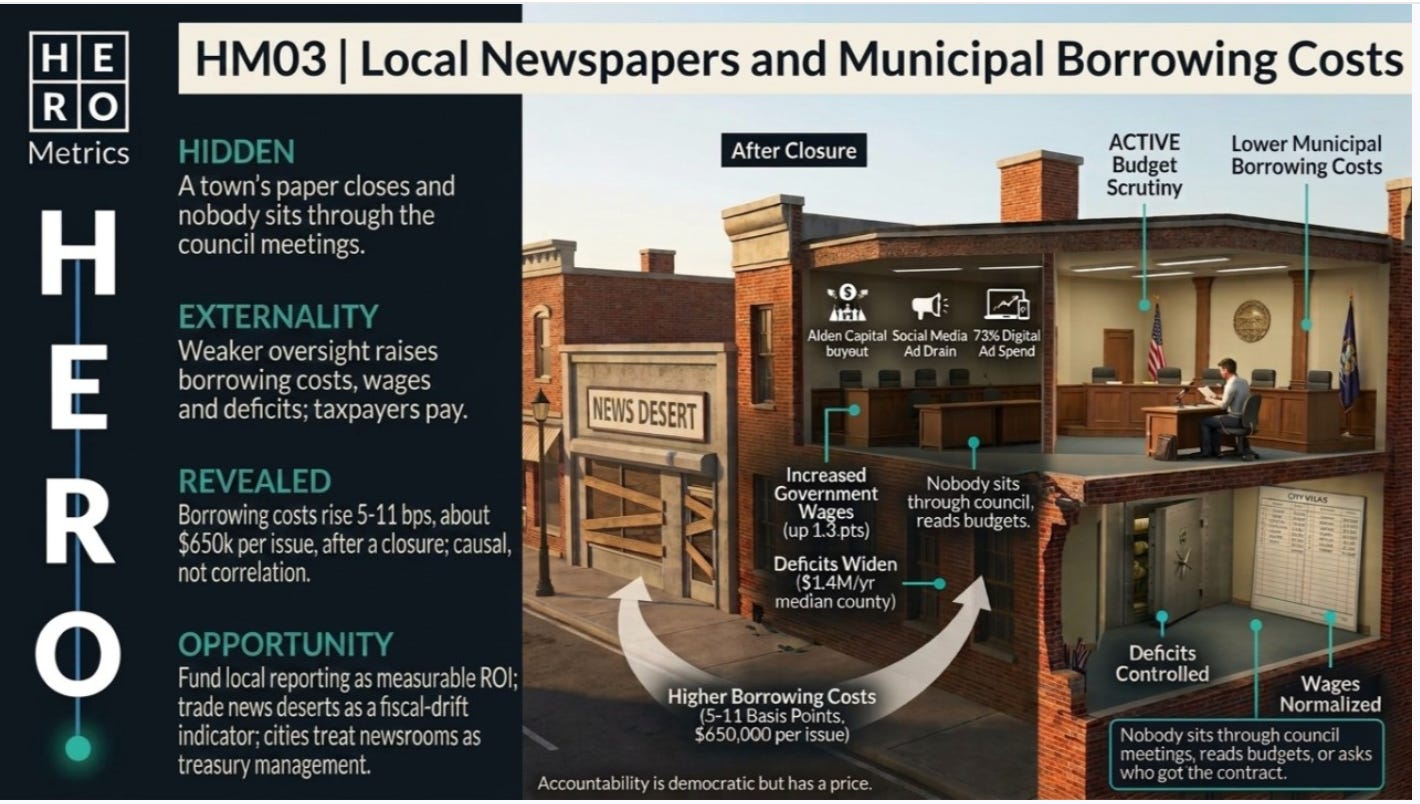
Following a newspaper closure, municipal borrowing costs increase by 5–11 basis points, costing the municipality an additional $650,000 per issue. This effect is causal and not driven by underlying economic conditions. The loss of government monitoring resulting from a closure is associated with higher government wages and deficits and increased likelihoods of costly advance refundings and negotiated sales. Overall, our results indicate that local newspapers hold their governments accountable, keeping municipal borrowing costs low and ultimately saving local taxpayers money
It seems that the clear-eyed bean counters in the bond market can put a value, and price, on local journalism, which, tragically, local citizens and businesses don’t seem to be able to. The mechanism is scrutiny. A local paper sits through council meetings, reads budgets and asks who got the contract. Once it closes, nobody does. The study finds that after a closure, government wage ratios rise by about 1.3 percentage points, roughly $1.4m a year in the median county, and deficits widen. Taxpayers foot the bill.
The decline of journalism
I grew up passionate about journalism; my first two jobs (if you don’t count gardening and being a barman) were in journalism. My first role was as a local feature writer and part-time advertising salesman for the Rutland and East Staffordshire Tatler. The magazine has now sadly passed, and perhaps my abject failure at cold-calling local businesses could have been a warning. My second job, an internship actually, was shadowing the political editor of The Economist; sitting in on their weekly editorial meeting was a career highlight. In that room of big brains, it was easy to feel the industry was both necessary and secure.
Unfortunately, journalism, especially local journalism, is in freefall. In the US, print newspaper circulation has dropped by 70% from 2005-2025, with more than 40% of all local newspapers closing. Incredibly, the industry has lost 75% of its workforce since 2005. Today, over 50 million people live in a news desert in the US, up from 37 million twenty years ago, and as a result, 1,525 counties rely on only a single source of news.
Where the money went
The causes are varied, but it’s clear that social media has sucked money out of advertising budgets; now, 73% of all advertising is digital, and more than half of that is controlled by Google and Meta. Further, we’ve seen hedge funds, such as Alden Global Capital, buy up and gut local newspapers.
Less scrutiny, more waste
The result is less independent transparency and oversight of local officials in power, and as such there’s more double-dealing, corruption, and waste, which then affects the financial viability of the town.
What the watchdog is worth
In the litany of bad news, this data should be a godsend. It seems like a perfect opportunity for a foundation to fund local reporting - part of the payback to the board should be a measurable discount on public borrowing. Bond desks could treat news deserts as a forward indicator of fiscal drift; the data is public and the lag is three years, so patient investors have time to use it. Once a city understands the interest bill attached to losing its paper has got a real number attached, subsidizing local reporting looks less like charity and more like smart treasury management.
Now put the two numbers next to each other. The extra $650,000 on a single bond issue is more than it costs to run many a small local newsroom for a year: the Gotham Gazette covers New York City politics on a $350,000 budget, and grassroots sites get by on a fraction of that, some on as little as $100,000. The town is not weighing a public good against a tight budget; it is paying more, in interest alone on a single deal, to be worse governed. The cheapest fiscal reform available to some of these counties would actually be a functioning local paper.
Alternatively, or in addition, there are also new models of charity, along the lines of tithing, where local people make pledges to support local journalism. Whatever works is worth a try.
Accountability is usually argued for in the language of democracy, which is real but hard to price. The bond market has priced it anyway. The finance wonks have worked out what the watchdog was worth; the rest of us are catching up.
The HERO summary
HIDDEN: A town’s paper closes and nobody sits through the council meetings.
EXTERNALITY: Weaker oversight raises borrowing costs, wages and deficits; taxpayers pay.
REVEALED: Borrowing costs rise 5-11 bps, about $650k per issue, after a closure; causal, not correlation.
OPPORTUNITY: Fund local reporting as measurable ROI; trade news deserts as a fiscal-drift indicator; towns treat newsrooms as treasury management.
About this newsletter: HERO Metrics follows the numbers that move systems. Each edition takes a single hidden signal, an external cost or a value that markets aren’t pricing, and looks at four steps: Hidden, the harm or worth sitting in plain sight; Externality, the way its cost lands on someone who never signed up for it; Revealed, the cheap new instrument or process that makes it legible; and Opportunity, what becomes real and fundable once it can be measured. Markets are one of civilisation’s great inventions. HERO Metrics aims to make them work better for everyone.