
This Edition has lots of newsworthy components: Big Tech corporate bad behaviour, rugged Nordic scenery, feisty locals, and wolves. It seems that Google’s Finnish developer felled an estimated 400,000 trees in northern Finland for AI data centres without the environmental impact assessment the law requires. The unintended consequence, which makes it a HERO Metrics story, was that wolves ended up coming into the village. So the bill for our chatbots is being sent to residents of small northern Finnish villages.
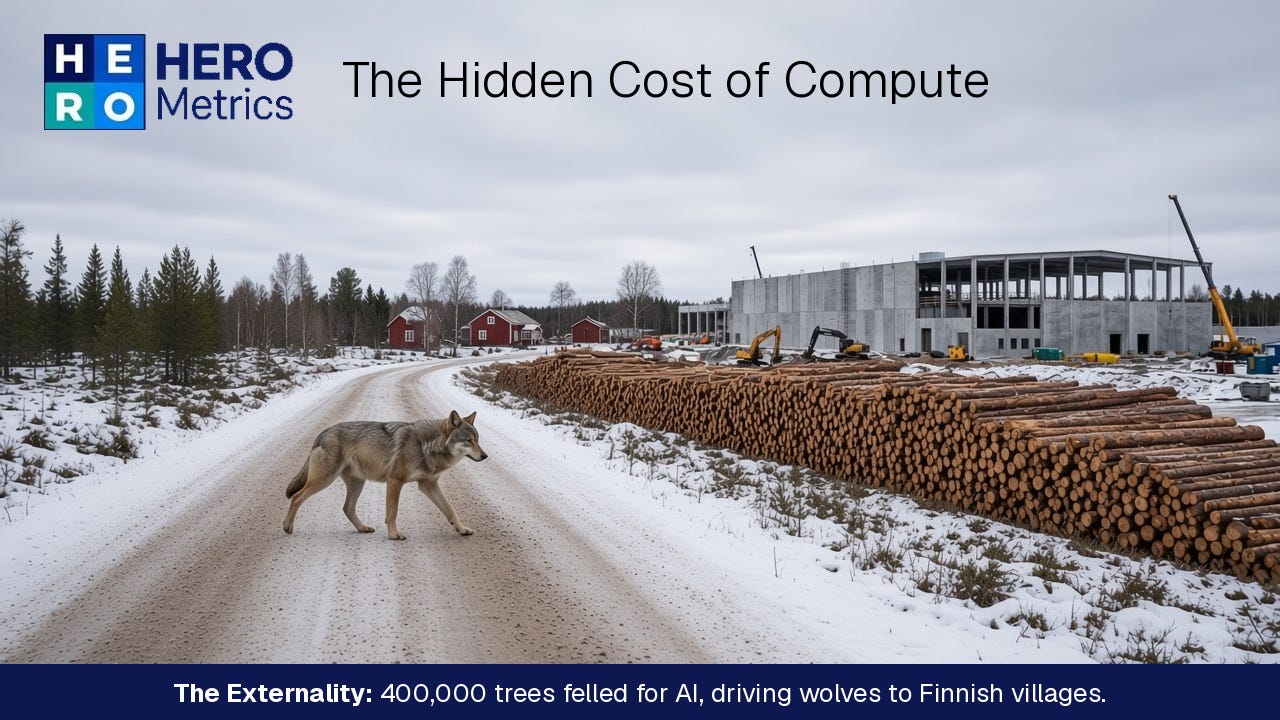
The developer Tuike Finland Oy cleared forest at two sites, Muhos and Otanmäki. After letters from the Finnish authorities on 6 October, work stopped, because the company had skipped the assessment. The sites are part of a $14.5 billion build-out Google announced in September, so this was not the best look for the start of a multi-year collaboration.
“We had wolves coming into the village because all the wild animals moved out of the forest,” Anni Ranta, 53, told the Guardian. Another resident called the method “American style.” [Editor’s note: That reminds me of being told I was “too American” in a meeting at Nokia once. I think they meant I wasn’t listening enough. In Muhos it meant clearing the forest first and asking afterwards.]
That is an externality in its plainest form: a cost that lands on people who never signed up for it. The villager did not train the model, does not price the tokens, and cannot send Google the bill if her lambs turn into wolf-lunch.
Otanmäki and Muhos are probably a preview. The IEA expects data centres to draw about 945 terawatt-hours by 2030, near 3 per cent of the world’s electricity, with AI the fastest-rising slice. Land, water and power all get drawn down, and little of that reaches the price of chatbot.
Finland has shown the cost can be made to appear. A regulator stopped work at two sites, which means the cost of compute can be counted before the trees come down rather than after. Finland has now launched a criminal investigation, so don’t expect this to go away anytime soon.
Public opinion is probably the bigger lever. We need to make it obvious and urgent to put nature into these megawatt calculations before the diggers arrive, so the economics of the next forest start to reflect reality.
In these newsletters, AI is usually the instrument that reveals a hidden cost. In Otanmäki it is the hidden cost, felled and stacked and visible from the air, and so far these villages are paying the bill.
About this newsletter: HERO Metrics follows the numbers that move systems. Each edition takes a single hidden signal, an external cost or a value that markets aren’t pricing, and looks at four steps: Hidden, the harm or worth sitting in plain sight; Externality, the way its cost lands on someone who never signed up for it; Revealed, the cheap new instrument or process that makes it legible; and Opportunity, what becomes real and fundable once it can be measured. Markets are one of civilisation’s great inventions. HERO Metrics aims to make them work better for everyone.