
The canopy dividend
A tree on a city street appears as a local council expense. Someone waters it, prunes it, sweeps the leaves and wrangles complaints about its roots lifting footpaths. The benefits arise elsewhere. An insect from East Asia ran an experiment nobody would have been allowed to design, and the benefit turned up in the death registry.
The emerald ash borer was found near Detroit in 2002. By 2012 it had killed about 100 million ash trees across the US. Geoffrey Donovan and colleagues at the US Forest Service followed it county by county, from 1990 to 2007, across 15 states. Writing in the American Journal of Preventive Medicine in 2013, they found that the borer “was associated with an additional 6113 deaths related to illness of the lower respiratory system, and 15,080 cardiovascular-related deaths.”
That’s 21,193 deaths, give or take, in the counties where the trees came down.
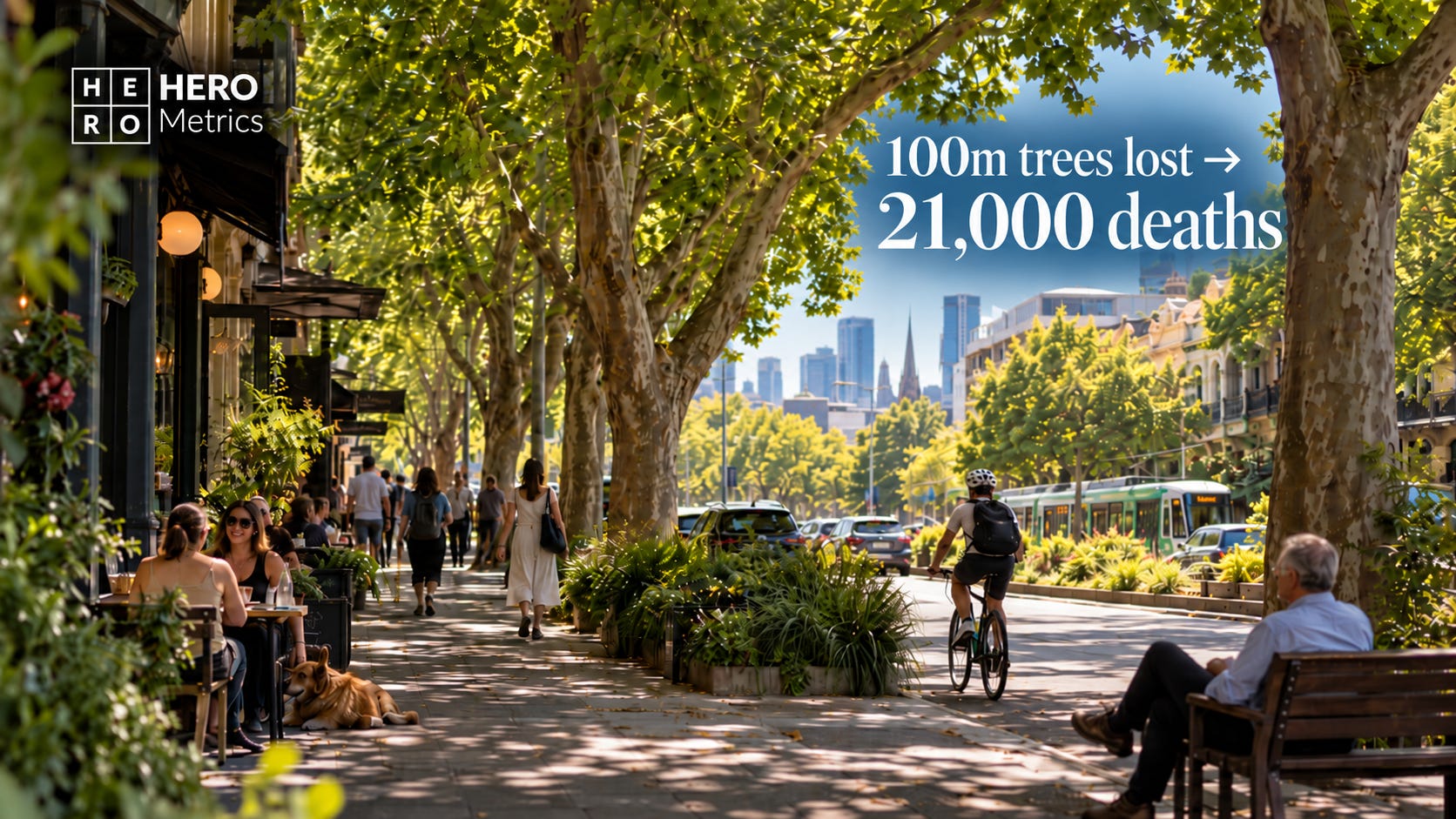
Hidden: the tree that only shows up as a cost
Nobody plants a street tree to cut the local cardiac admissions. People plant them for shade, for looks and for property prices, and councils pay for them out of rates. The health effect, if there is one, sits outside the budgets that touch the tree.
The beetle created a natural experiment, that is not normally possible. Most research on green space compares leafy suburbs with bare ones, and leafy suburbs tend to be richer, healthier and better at going to the doctor. Donovan’s team had something closer to a natural experiment: the borer arrived in some counties and not others, at different times, for reasons that had nothing to do with the health of the people living there. The effect grew the longer the infestation ran.
Externality: the council’s tree, the hospital’s bill
When a council loses trees or fails to plant them, the cost lands in a different world. In Australia, heart attacks and strokes are paid for by state hospitals, Medicare, the PBS and private health funds. Life insurers carry the deaths. None of them owns a single street tree.
The pattern repeats in other studies:
Women’s Health Initiative. Donovan’s team went back in 2015 with individual-level data from this large study of post-menopausal American women (Health & Place). Women living in a county infested with the borer had a higher risk of cardiovascular disease (hazard ratio 1.25, 95% CI 1.20 to 1.31). The outcome covered heart attacks, strokes and coronary death.
Portland. A 10% increase in tree canopy within 50 metres of a home was linked to 1.42 fewer small-for-gestational-age births per 1,000 (Health & Place, 2011).
Toronto. Omid Kardan and colleagues found that ten more trees on a city block went with better self-rated health. The improvement was comparable to a $10,000 rise in income, or to “being 7 years younger” (Scientific Reports, 2015).
Revealed: the data was always there
None of this needed new science. The ingredients sat in three unconnected places: a federal map of where the beetle had spread, county death records, and land-cover imagery. The insight came from holding them up against each other.
Australia already has most of the pieces.
Melbourne’s targets. In 2012 the City of Melbourne set a goal in its Urban Forest Strategy to lift public-realm canopy from 22% to 40% by 2040. It also capped any one species at 5% of the tree population. That cap is a lesson learned from leaning too hard on elms and planes, much as American cities leaned on ash.
National benchmarking. RMIT’s benchmarking for Hort Innovation and Greener Spaces Better Places tracks green cover across 131 urban council areas. By 2020, 69% of them still had less green cover than in 2013. Its Victorian snapshot put average urban canopy at 18.83%, down from 20.89% in 2013.
Heat. The January 2009 heatwave in Victoria caused an estimated 374 excess deaths, a 62% rise on the expected toll (Victorian Department of Human Services).
Shade is the most obvious mechanism tying canopy to health. It is one of several candidates: cleaner air, lower stress and more walking are the others. Nobody has pinned down which does the work.
The caveats
A natural experiment is stronger than a snapshot. It is weaker than a trial. Donovan’s 2013 study works at county level, so it can’t say who died or why, and critics have pointed to wide error bands and a weak result in the control model for accidental deaths. The authors themselves wrote that “little is known about the mechanisms linking trees and cardiovascular disease.” Kardan’s Toronto study and the Portland birth study are associations. Treat the numbers as a signal worth acting on, and test them before anyone bets a health budget on them.
Opportunity: a canopy dividend
If tree loss raises heart and lung disease, then tree cover has a value for health budgets. Several of the levers of systems change could help turn this into an opportunity:
Research. Link Australia’s canopy data (satellite and LiDAR, council tree inventories) to hospital admissions and deaths by small area, and test whether the American finding holds here. Victoria, with its heat record, canopy targets and linked health data, is the natural place to start.
A metric. A canopy dividend would estimate the health cost avoided per hectare of canopy, by suburb. Councils would get a number to set against the pruning bill. Health funds would get a number they can recognise.
Capital. A health fund, a state health department or a life insurer could co-fund planting in low-canopy, high-heat suburbs, with payments tied to measured canopy growth. A green bond or outcome contract could carry the upfront cost until the evidence matures.
Regulation. Planning rules that count tree loss on private land as a health cost, where much of the recent decline has happened.
Councils plant the trees and health budgets bank the savings. Once there’s a number connecting the two, the second has a reason to help pay the first.
As always, feedback and suggestions welcome.
About this newsletter: HERO Metrics follows the numbers that move systems. Each edition takes a single hidden signal, an external cost or a value that markets aren’t pricing, and looks at four steps: Hidden, the harm or worth sitting in plain sight; Externality, the way its cost lands on someone who never signed up for it; Revealed, the cheap new instrument or process that makes it legible; and Opportunity, what becomes real and fundable once it can be measured. Markets are one of civilisation’s great inventions. HERO Metrics aims to make them work better for everyone.