
The wolf dividend
Re-introducing wolves into the environment has been a hotly debated issue. The main costs measured by a cost to ranchers’ livestock (wolves have got to wolf). However, if you add in the value to society of avoided vehicle collisions with deer, the benefits generally outweigh the cost 63 times.
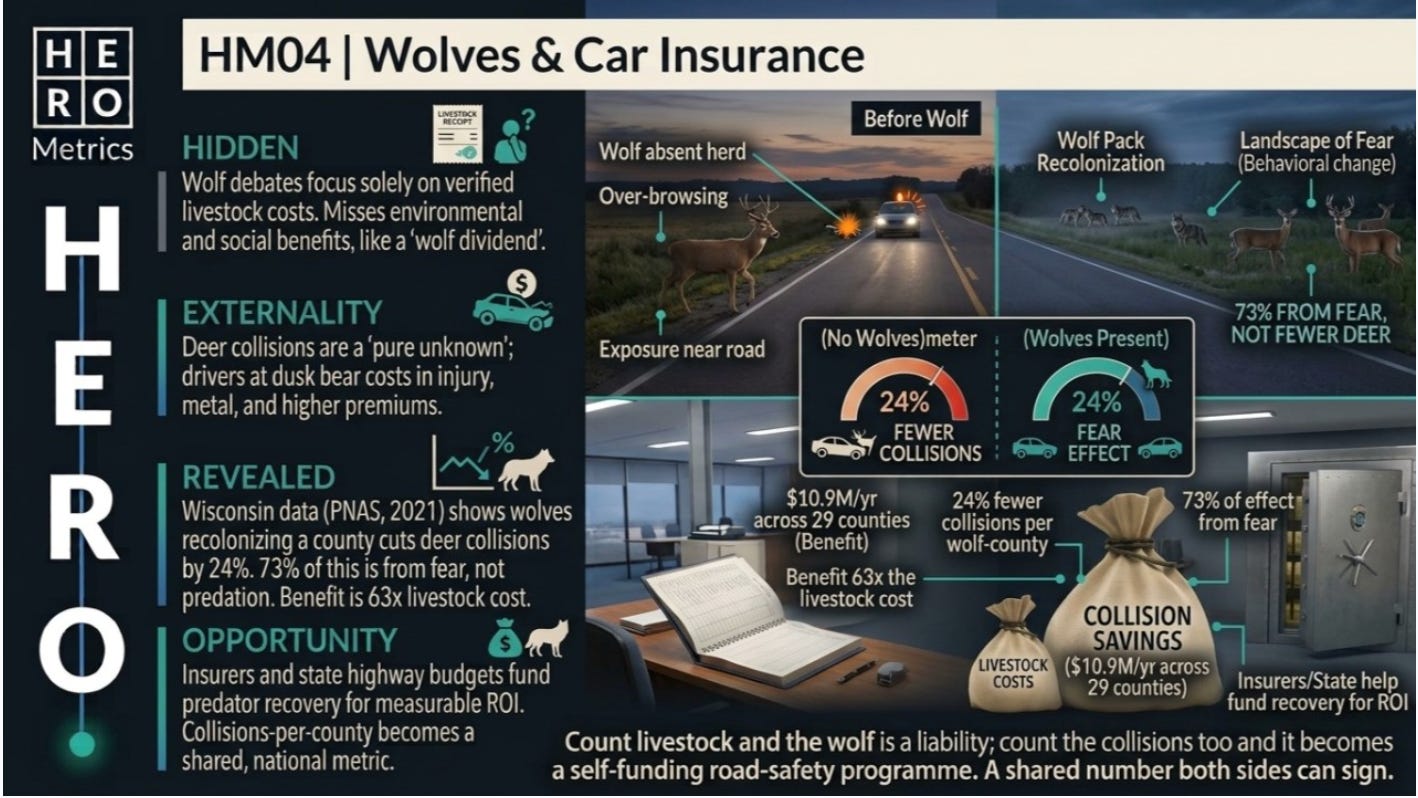
The most valuable thing a wolf does in Wisconsin is not kill deer; it frightens them. A returning pack does not have to thin a herd to change a county, because deer that live in fear of wolves move differently, keeping away from the ditches, verges and open crossings where they are most exposed, and it turns out that roughly seventy-three percent of what follows comes from frightened deer rather than fewer deer. Jennifer Raynor, Corbett Grainger and Dominic Parker found the effect in an unlikely dataset: car-crash records. Writing in the Proceedings of the National Academy of Sciences (PNAS) in 2021, they showed that once wolves recolonise a county, collisions with deer fall by about 24%.
The politics of the wolf runs on one side of the ledger
The wolf is fought over in courtrooms and ballot measures across the American West, and the argument runs almost entirely on what a wolf takes from a rancher. That number is real, verified and compensated, so it dominates every hearing. The benefit side has never had a number to set beside it - it was sitting off the farm entirely, in the insurance data.
The fear does the work
The famous version of this story is Yellowstone, where wolves returned in 1995, the elk stopped over-browsing the willow along the rivers, and the beaver and songbirds came back behind them: a cascade that became a viral parable about one predator rewiring a whole valley. Wisconsin is the same mechanism with a price tag attached. Ecologists call it a “landscape of fear”: a prey animal avoids the places a predator hunts, i.e. roads. That behaviour produced around 38 fewer collisions in the average wolf county every year. The deer a wolf eats matter less than the deer a wolf scares.
The benefit hides in the insurance ledger
Across the United States each year, deer collision cause 29,000 injuries, 200 deaths and close to $10bn costs of car wrecks of collisions, hospital stays and higher premiums. In the 29 Wisconsin counties wolves had returned to, the avoided collisions were worth $10.9 million in total, around $375k per county. Set against the verified cost of wolves killing livestock, the benefit runs 63-to-1.
Several of the six levers of systems change:
Research. Build the thing the paper only sampled: a collisions-per-county panel, run nationally, that turns predator range into a line an actuary can actually read.
Capital. An insurer or a state highway budget that saves $375,000 a county has a reason to help pay for predator recovery that no conservation appeal has ever been able to give.
Public opinion and regulation. A rancher and collisions are, for once, looking at one number they can both sign, and that is the thing that moves a delisting hearing.
Restoring the wolf paid a dividend that was hidden, revealed in fewer wrecks on the county roads at nightfall.
As always, feedback and suggestions welcome
About this newsletter: HERO Metrics follows the numbers that move systems. Each edition takes a single hidden signal, an external cost or a value that markets aren’t pricing, and looks at four steps: Hidden, the harm or worth sitting in plain sight; Externality, the way its cost lands on someone who never signed up for it; Revealed, the cheap new instrument or process that makes it legible; and Opportunity, what becomes real and fundable once it can be measured. Markets are one of civilisation’s great inventions. HERO Metrics aims to make them work better for everyone.