
Ambient noise costs children months of reading and adults years of heart health, yet we account for neither. This Second Edition of HERO Metrics follows another negative externality that few people are capturing, though they easily could. In fact this one has an easier fix than the water testing of Edition 1. This topic is particularly live for me now - I’m building my own audio testing kits for a work project, and am writing from Seoul, where I’m meeting acoustic biomarker startups.
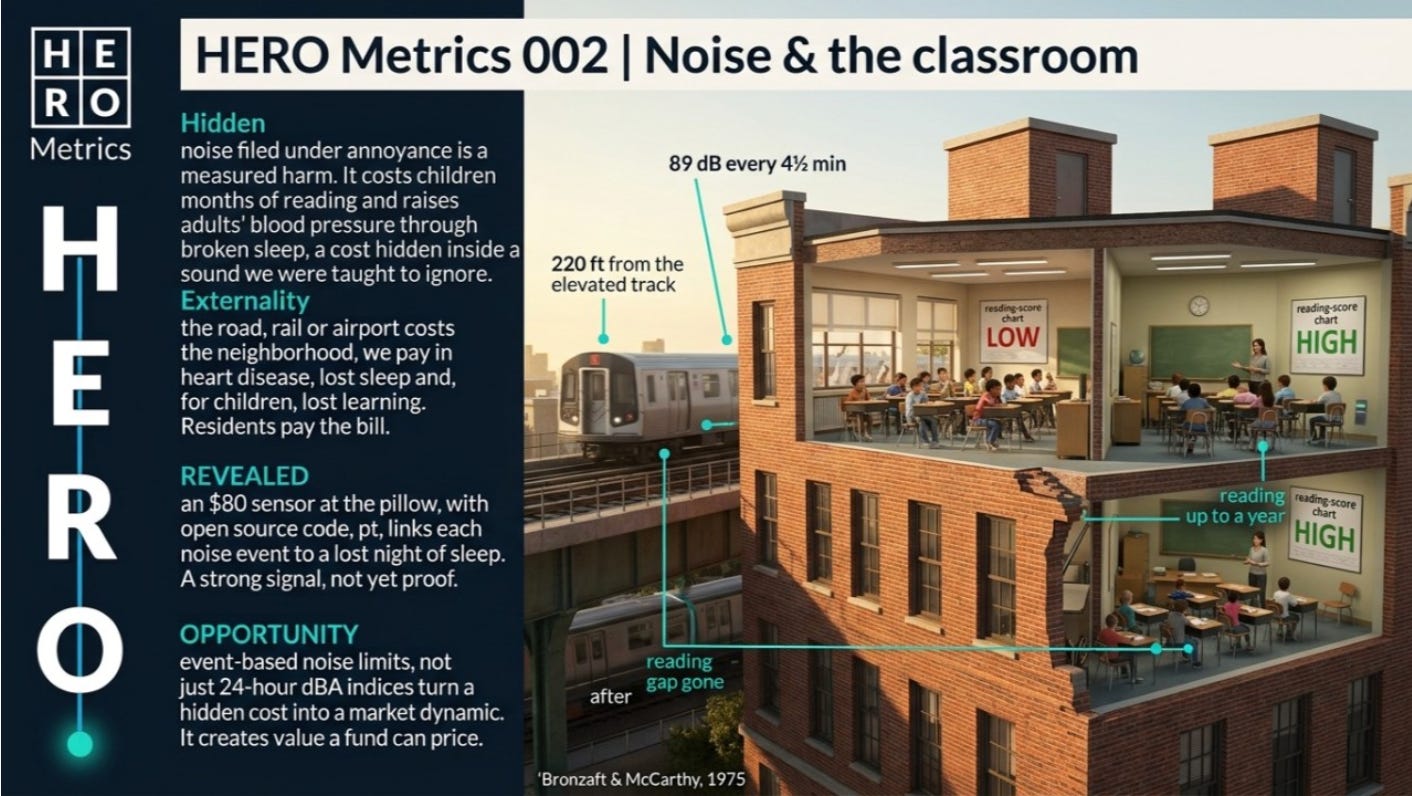
Here’s how Ambient Noise tracks on our H-E-R-O frame:
Hidden
Chronic noise is a modern phenomenon - not much of it in the countryside. The cleanest evidence of harm is already fifty years old - from Public School 98 in Manhattan. An elevated train ran about 220 feet from one side of the building, disrupting the noisy-side classrooms every four or five minutes. In 1975 the environmental psychologist Arline Bronzaft compared children’s reading scores according to which side of the building their classroom faced. On average the noisy-side classes lagged three to four months behind the quiet-side; the worst eleven months behind. Same school, same teachers, same curriculum, same children, the only variable being the wall. Then the HERO part of the story: the transit authority laid resilient rubber pads under the track to keep the noise down, and the reading gap disappeared. Simple rubber pads helped kids gain a year of reading.
It is not just the kids. The same nights that cost them reading are, for the adults in the same houses, a cardiovascular insult. According to the World Health Organization, more than a million healthy life-years are lost every year to traffic noise in western Europe. The European Environment Agency says a full one in five Europeans (110 million) suffer from noise pollution, which results in 66,000 premature deaths, 50,000 new cases of cardiovascular diseases and 22,000 new cases of type 2 diabetes. Additionally, noise could cause thousands of cases of depression and dementia. While the word is out about air pollution; noise pollution is still thought of as an annoyance rather than a health burden.
In health, the pathway is fascinating, and missing from the measurements. Noise spikes fragment sleep: it activates the sympathetic nervous system, increases cortisol, leads to endothelial dysfunction and raises blood pressure. Sustained across years, these correlated with hypertension and with downstream heart disease. You don’t even have to wake up.
On Saturday night in Tokyo I had my own cortisol spike. At two in the morning, a few hours into sleep, I woke to blaring klaxons and a tannoy screaming “Earthquake! Earthquake!”. That was genuinely a freak-out moment, six floors up. I felt, physically and metaphorically, at sea. My phone lit up with the same warning: “strong shaking expected soon, seek shelter nearby”. The point is not the drama; it’s the cortisol spike. It took me two hours to get back to sleep. That was the loud, conscious version. The sneakier one is likely happening every day - truck deliveries at 3am or the plane on approach that does the same thing to your body without ever waking you.
Externality
Noise is already measured, but not in the right way. The way it’s been done doesn’t reflect the impact it has on people. In particular with health: it’s measured as an average; the average is not the point; the spikes are. The costs to society hide in the spikes, especially relating to the cardiovascular and cortisol issues. The operator of the road, the rail line or the airport captures the benefit, while the residents underneath pay in heart disease, lost sleep and, for children, lost learning, none of which costs the operators anything. The average stat fails in three ways:
Theoretical. The map that decide planning permission, night curfews and compensation are usually computed from traffic-flow data and propagation models, rarely checked against a real reading at anyone’s actual window.
Averages. They are reported as an annual average, the Lden and Lnight metrics, but the harm comes from events; a night with a handful of loud pass-bys can post a respectable yearly average while wrecking the sleep of everyone beneath it.
Static. Reroute the freight line or open a depot that takes deliveries at 2am, and the map that decides your rights may not be redrawn for a decade.
Averaging is simply the wrong operation for this exposure. The official metric is not just coarse and stale; it is unable, by construction, to see the mechanism through which noise does its damage.
Revealed
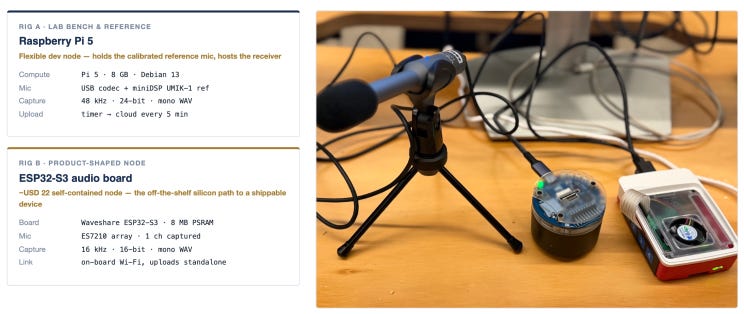
What has changed - and this is the key to this entire newsletter - is that measurement has become cheap enough for those exposed to take things into their own hands, and build datasets themselves. New York University’s Sounds of New York City project has run more than fifty calibrated acoustic nodes since 2016, logging over 150 million ten-second recordings at an accuracy adequate for most noise codes, mounted high and far-field so the speech that reaches them is judged unintelligible. And I have been testing sound recording for a project of my own; it is remarkable how far you can get with hacking hardware nowadays. Raspberry Pi 4 does genuinely sophisticated processing, and where you need only the raw sound-pressure reading an ESP32 board will do it for about $20. The privacy objection is pretty easily dealt with - don’t share raw data, just the insights (’seventeen pass-bys above sixty decibels between midnight and six.’)
Even simpler than a dedicated audio device is a phone. There are already sleep apps that measure sleep - you can have your iPhone listen for apnea, so why doesn’t it also listen for environmental sounds? These could be joined together to create swarm intelligence.
I’ve not seen anybody connect the wearable data with sound as a biomarker, but it surely wouldn’t be hard. Pair that node with the sleep data from the wearable already on the resident’s wrist, and you link a measured noise to broken sleep. No airport authority, health department or consultant holds this - none could assemble it without the residents. It is a dataset a town of two thousand people could build this year.
Opportunity
Once the signal is legible it becomes actionable, and fundable. A measured, event-based, address-level noise index is a sellable to property valuers, lenders and insurers. It can benefit both sides - checking reality rather than assumptions (maybe those planes aren’t that loud after all...). Measured evidence gathered over a year is different than a resident swearing ‘it feels loud’. And acoustic glazing, facade insulation and quiet road surfacing are mature technologies held back mainly by the absence of a before-and-after number to make them fundable.
In my work, I generally see six levers of systems change: capital, research, startups, regulation, public opinion and orchestration, and this pulls on three of them. Research, in particular a new citizen-science created dataset. Public opinion, because the person kept awake now can point to evidence. And regulation, because whoever can prove averages don’t predict harm can help set better rules.
So now is the time to ask you to give me your sound stories; have you seen projects looking to make this link? Let me know what you agree / disagree with, and if you have other HERO Metrics to share.
About this newsletter: HERO Metrics follows the numbers that move systems. Each edition takes a single hidden signal, an external cost or a value that markets aren’t pricing, and looks at four steps: Hidden, the harm or worth sitting in plain sight; Externality, the way its cost lands on someone who never signed up for it; Revealed, the cheap new instrument or process that makes it legible; and Opportunity, what becomes real and fundable once it can be measured. Markets are one of civilisation’s great inventions. HERO Metrics aims to make them work better for everyone.