
Living within a mile of a golf course is associated with roughly double the odds of developing Parkinson’s disease. This is not what most wealthy, links-loving retirees signed up for. And though the research says correlation, not causation, the pathway seems fairly clear (pesticides - see below). This would be an ironic turn of events for those who’ve lived a healthy life and want to optimize their golden years. Or indeed for anyone who happens to drink water in places where industrial quantities of potentially toxic chemicals flow into the water table.
That disconnect is the point of this newsletter, HERO Metrics, which looks to surface externalities such as this, and start to fix broken systems.
The May 2025 study in JAMA Network Open, led by researchers at the Mayo Clinic and Rochester Epidemiology Project, looked at 419 people with Parkinson’s set against 5,113 matched controls, tracked from 1991 to 2015. One of the authors, Prof Ray Dorsey, a long-time friend and colleague, has done more than most to reframe Parkinson’s as a largely man-made disease rather than an inevitability. He’s published two well-received books (The Parkinson’s Plan in 2025 and Ending Parkinson’s Disease in 2020). His colleague, and lead researcher on the project, Brittany Krzyzanowski PhD, spoke with me a few months ago about her research. It was a fascinating conversation due to its unintuitive finding, and more importantly, it sparked loads of ideas about what could be done about it (hint: think distributed, collective action).
Each edition takes a single hidden signal and follows it from invisible to investable, through the four moves: Hidden, then Externality, then Revealed, then Opportunity. Here is the golf course through all four.
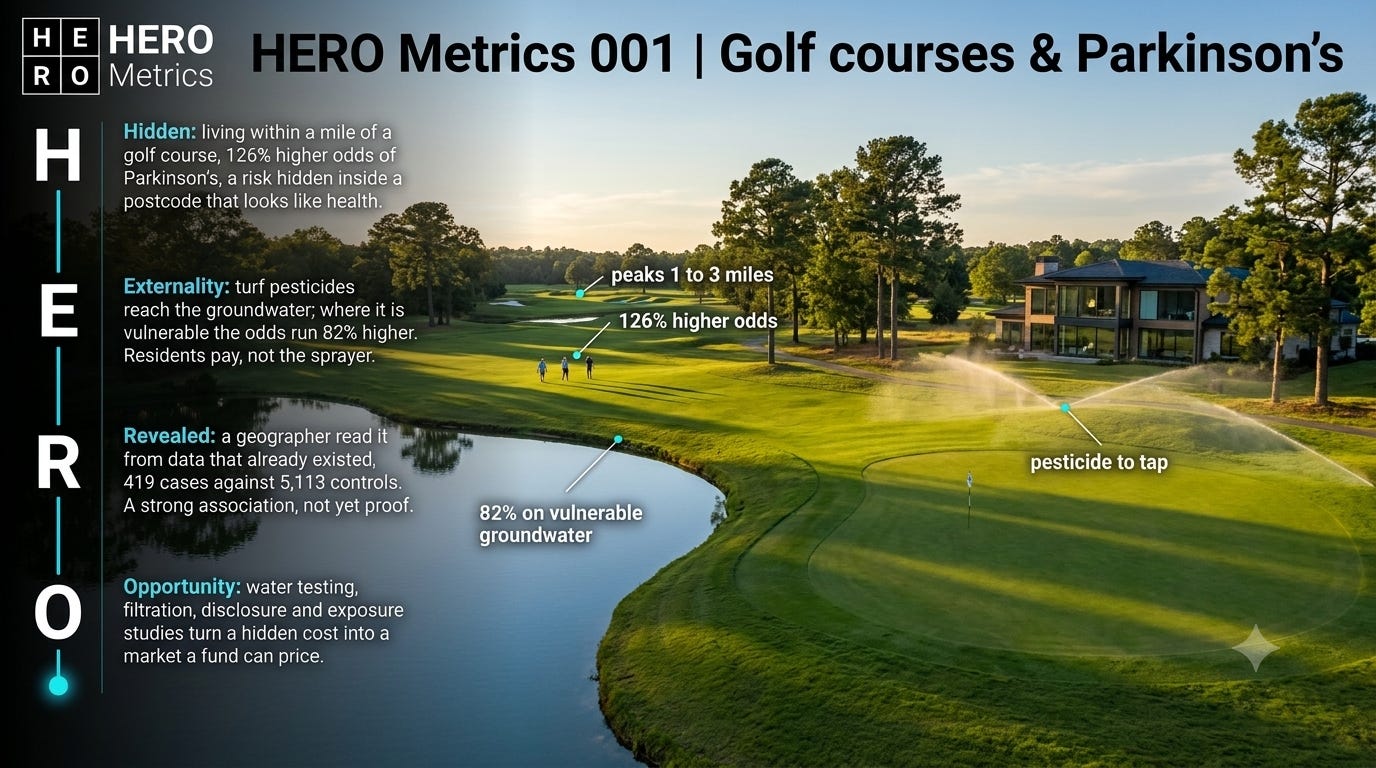
Golf courses and Parkinson’s have a surprising and unsettling relationship
Hidden: Green space, clean air, oh, and higher odds of Parkinson’s
Buying a house by a golf course reads as buying health: green space, clean air, a daily walk on the links, the reward at the end of a working life. The Mayo data complicates that picture. Within a mile of a golf course the adjusted odds of Parkinson’s ran 126% higher, and the risk held between one and three miles out before fading with distance. A signal this counterintuitive stays invisible for a plain reason: nobody shopping for a fairway view is looking for it.
Externality: The greens budget becomes the neighbour’s neurology bill
My experience taking Economics at Cambridge University left me a little frustrated - there were far too many assumptions about perfect markets and homo economicus. However, a highlight was the learning about concept of externalities, which has stayed with me, and in my view, helps explain much of what is wrong with today’s overly financialised world.
An externality is a cost pushed off a company’s books and onto everyone else’s, something that Kate Raworth and Mariana Mazzucato among others have championed. Here the pathway runs through the tap. In water service areas that contained a golf course the odds of Parkinson’s were close to twice those of areas without one.
Krzyzanowski told me golf courses are sometimes treated with pesticide at heavier rates than farmland (that impossible green is a chemical achievement), and that the worst aquifers are a particular geology, “full of holes and crevices, so when it rains the agricultural chemicals fly right through and get straight to the water.” Where the water sits on that vulnerable ground, the odds of Parkinson’s ran 82% higher than in comparable areas. In some places, she said, those chemicals have shown up in groundwater at two hundred times the legal limit. The pesticide keeps the fairway green, travels through the aquifer, and reaches people who never chose the exposure and will never see a bill for it. Someone pays; it is just not the person who sprayed the grass.
Revealed: The data sat for decades, waiting to be read
Records like these have sat around for decades, scattered across turf-management logs, aquifer maps and disease registries that nobody had held up against each other. That’s where Krzyzanowski thrives. “I don’t have to go out into the field and collect water samples and draw blood,” she told me. “I’m just downloading a data set somebody already made, and running models with it. That’s the beauty of being a geographer.”
The craft is turning messy data into insights. Every golf course was treated as a single pin dropped in its car park, useless for working out who lived close, so she drew the boundary of each course by hand; for the nationwide follow-up, tens of thousands of courses, she has opened a public map with instructions that let anyone trace one, credited by name.
The paper is a case-control study, so it shows a strong association and stops short of proving cause, and it could still be confounded by age, wealth, or where people happen to draw their water. Her summary of the field is the reason this newsletter exists: “researchers all over the world are modelling these toxins, and nobody’s taking the data and testing it.”
A signal engine that only produces exciting findings is worse than useless, so the job is to attack each one and keep what survives. This one, probably, survives long enough to be worth acting on before the science is fully settled.
Opportunity: Measure the exposure, and prevention becomes a market
A revealed signal is only worth anything if someone can act on it, and this one opens moves across the system at once:
Test and filter. Home and municipal water testing, and filtration for households on vulnerable groundwater, are buildable today.
Disclose. Proximity and water-source disclosure at the point of sale, the way flood risk slowly became a line you could read on a listing before you bought.
Research. The individual-level exposure studies that would move this from association to cause, and settle it either way.
Fund. Capital that treats a health-and-environment signal as an opportunity rather than a liability.
Brittany’s work ignited global coverage (including here in Australia) and she’s been invited to Tasmania in 2027 to help build something like this in Australia. She’s also just published new research in Nature that shows the link - again, in a dose-dependent way - between living in proximity to a dry cleaner’s and developing Parkinson’s. Another of her findings shows a correlation between newer groundwater (which is more exposed to chemicals) and Parkinson’s. One of the findings was that water drawn from porous, chemical-absorbing carbonate aquifers carried up to 62% higher Parkinson’s risk than water from glacial aquifers. It’s as if toxic chemicals that fry your brain shouldn’t just be dumped into local water supplies...
This is bigger than one disease. Donella Meadows argued that the highest leverage in a system is often the flow of information: what gets measured, and who is allowed to see it. A signal that improves healthspan and lightens the environmental load at the same time is a number that I’d like to know more about.
What this newsletter is for
HERO Metrics is a newsletter designed to build - in public - something bigger, a better way to run our economy and our society. If we can chip away at these externalities one by one we’ll hopefully close some of the ways in which capitalism is broken. I’m a big fan of markets, competition and of capitalism (which, as Peter Thiel points out, is often the opposite of competition). But the current neoliberal, profits-above-all implementation has gone too far - it’s not just wrong, but it’s bad for the capital owners, as our societal connective tissue, our climate boundaries and institutional capabilities are breaking down. It happened slowly, now it’s happening rapidly.
Researchers and outraged citizens (in particular those affected) have little agency in today’s world compared to Big Corporate and politicians who rarely pass legislation based on what people actually want. What the research team cited above found was not really a story about golf; it was about a health signal sitting in ordinary data that the market, and the property market especially, has no way to see. And that got me thinking, what else is like this?
This case study suggests a pathway to do something about it: consumer advocacy -> data gathering -> impact validation -> theory of change -> measurable, real-world impact. Some of these metrics will survive scrutiny and some will not, which is the point of doing it in the open. Krzyzanowski is already building the next version of her golf-course map from the public, one credited contributor at a time; and I would like to hear from you if you know of other externalities that could move systems.
If you are sitting on a number no one seems to be pricing, a signal you have noticed and cannot stop seeing, send it: the strongest ones show up in a future edition, credited by name. As always, feedback and suggestions welcome.