
Close the last school in a French town and its vote lurches. Leave a shuttered Chicago school to rot and the shootings around it climb. Same budget decision, two hidden invoices, and neither lands on the spreadsheet that called the closure a saving.
Last week I wrote in Looking Forward that Australia’s populist surge maps onto government neglect, health resilience alone explaining 63 per cent of variation in the One Nation vote. That is a pattern - these two studies confirm the dynamic.
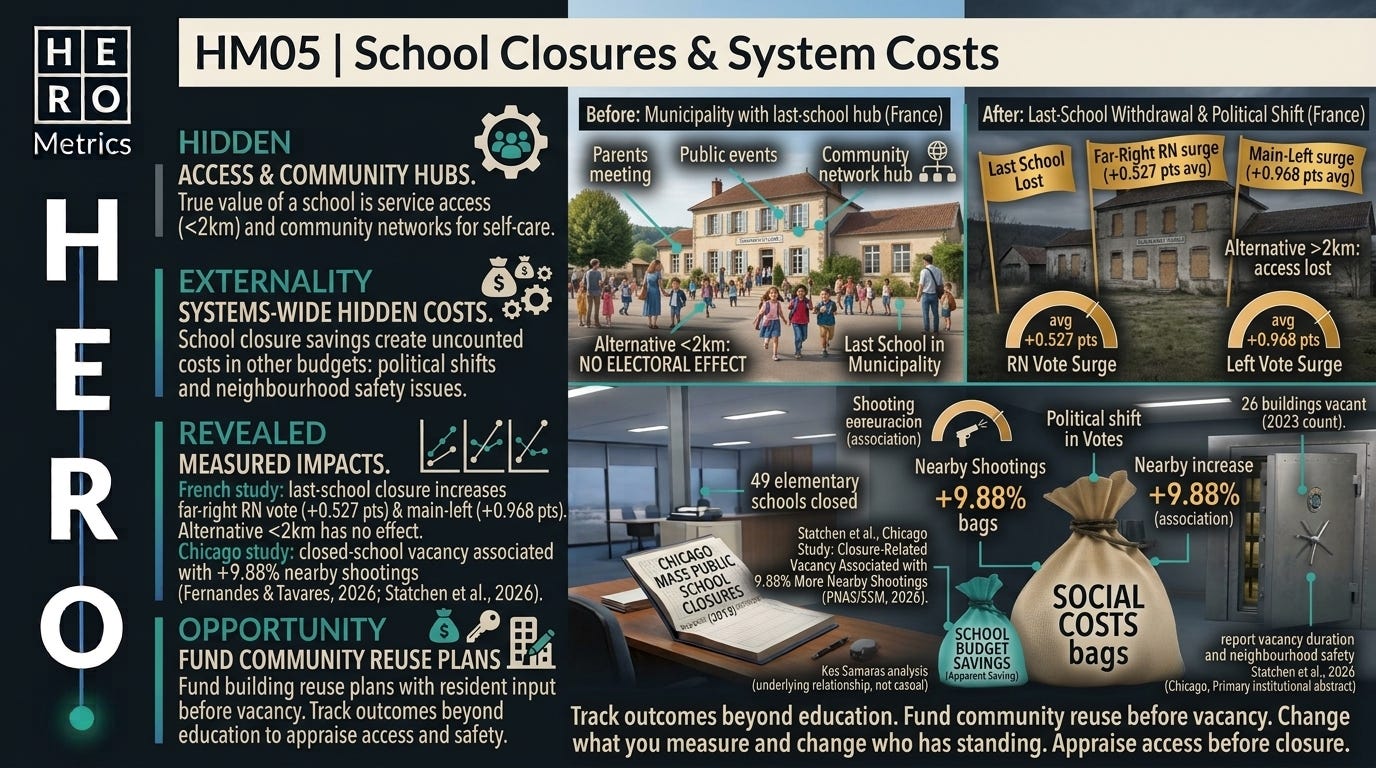
The last school changes the vote
In the Journal of Economic Geography, Marli Fernandes and José Tavares tracked French towns that lost their only school against near-identical towns that kept theirs, every presidential election from 1995 to 2022. Lose the last school and the far-right vote rises 0.53 points, the mainstream left 0.97. Whole towns moving, not polling noise.
What matters is that it is the last school. Keep a second school, or another within two kilometres, and the effect vanishes. Local access to services moves votes. The far-right gain shows up only where abstention was high and the mainstream was already weak.
The empty building draws gunfire
Chicago asked a similar question in a different context. In 2013 it shut 49 elementary schools; a decade on, 26 still stand empty. In Social Science & Medicine, Thomas Statchen and colleagues matched the blocks around them against blocks around schools left open: shootings ran about 10 per cent higher, concentrated where the building was left to rot rather than reused. An empty school is a dead space a neighbourhood has to live around.
Both are observational, one country and one city. But the damage tracks vacancy, not closure alone, and vacancy is a choice.
Count what you are actually cutting
Here is the budget question the spreadsheet doesn’t ask: what does keeping this place cost, against what losing it costs? Donella Meadows put what a system measures near the top of her leverage points, far above the line item that triggers a closure. Measure only the saving and you keep shutting things that bill you back in votes and gunfire.
That gap is the opportunity. The studies price the withdrawal; the move is to fund the building’s next life before it goes dark. Australia’s map of neglect gives some good places to start. How can we start to include these disparate, downstream costs on the town’s short-term balance sheet?
About this newsletter: HERO Metrics follows the numbers that move systems. Each edition takes a single hidden signal, an external cost or a value that markets aren’t pricing, and looks at four steps: Hidden, the harm or worth sitting in plain sight; Externality, the way its cost lands on someone who never signed up for it; Revealed, the cheap new instrument or process that makes it legible; and Opportunity, what becomes real and fundable once it can be measured. Markets are one of civilisation’s great inventions. HERO Metrics aims to make them work better for everyone.